Saturday, August 31, 2019

Mything Links

Recently I had reason to think about the concept of degrees of separation.  The idea that everyone in the world is connected by six or fewer acquaintances--the Six Degrees of Separation thesis-- was proposed by a Hungarian writer in 1929, and made famous by a 1990 play of that title by John Guare.

Various studies of often shaky procedures have attempted to test it, with mixed results. One suggested that the number of connections that link nearly everyone on the planet more likely exceeds ten.  But the idea has fascinated people anyway.

There is in particular a game called Six Degrees of Kevin Bacon, in which players attempt to connect a given actor to the actor Kevin Bacon, who had claimed to have worked with or known everybody in Hollywood.  The first--and probably the only--game I ever played online was a variation of this.  I don't remember the site that hosted it, but the game was to propose the names of two actors, and the person who could connect them first through movies they were in, and with the fewest links, won that round and got to propose the next pair.

So the names could be Will Smith and Laurence Olivier.   Here's how that might go: Will Smith was in the film version of Six Degrees of Separation with Ian McKellen.  McKellen starred in a film version of Richard III with Maggie Smith. Maggie Smith played Desdemona in a film version of Othello starring Laurence Olivier.  (There's also another path to Maggie Smith and Othello.)

Or Will Smith was in several Men in Black films with Tommy Lee Jones, who was in Lincoln with David Straithairn, who starred in Good Night, and Good Luck with Robert Downey, Jr. who costarred with Gwnyeth Paltrow in several Iron Man films and with Jude Law in several Sherlock Holmes films; both Paltrow and Law starred in Sky Captain and the World of Tomorrow, which featured a video cameo by Laurence Olivier.  

But what interests me are connections in real life, especially mine. Mostly but not only, from years as a journalist, I've met a number of people who provide connections to a lot of prominent people in various fields. Some (but not all) were or are themselves pretty prominent.  Through spending time with Billy Joel and briefly meeting Paul Simon, I am two degrees from, say, Paul McCartney (I have several other routes to being 2 degrees from John Lennon and George Harrison) as well as Springsteen, Sting and, of course, Garfunkel.

 Through a brief exchange with Neil Armstrong, I am 2 degrees from probably every astronaut who rocketed to the moon, and through Nichelle Nichols, several women astronauts on the Shuttle.  From meeting Kim Stanley Robinson and Ursula Le Guin, I am 2 degrees from any number of science fiction writers, and by several routes (including agents and editors), 2 degrees from any number of novelists, such as Jim Harrison.  I am even 2 degrees from the super-reclusive Thomas Pynchon, because he once lived here on the North Coast for awhile, and I met someone who met him.

Through Frank Rich (NYTimes theatre critic) and a lot of theatre actors (for example, at the O'Neill Center) I'm second degreed with a lot of stage names, and probably third degreed with many more. And through Janet Maslin (NYTimes film critic), as well as my own interviews with film actors and directors (especially veterans like Martin Ritt) as well as several friends who wound up in the movie biz (not to mention a memorable encounter with the young Karen Allen), I've got a number of additional two degree Hollywood connections to rival Kevin Bacon. Names newly prominent might require an extra degree.

Not bad for somebody you never heard of, as well as somebody a lot of these famous secondary connections never heard of either.

But what about degrees of separation across time as well as social and other kinds of space?   That's what fascinates me now.

For example, if a simple handshake creates a degree, my separation from President John F. Kennedy is 1.  Otherwise it is 2.  Through Harris Wofford (former US Senator from PA, with whom I worked on a project when he was PA Secretary of Labor and Industry) I am 2 degrees from JFK as well as RFK and Martin Luther King.

I am 2 degrees from President Obama, through Knox classmate and friend John Podesta, and he is my most direct connection to a number of Washington figures of the present and recent past, including the Clintons.  (I am also distantly related to the Bushes, Clintons and Obamas, though that's more tenuous.)


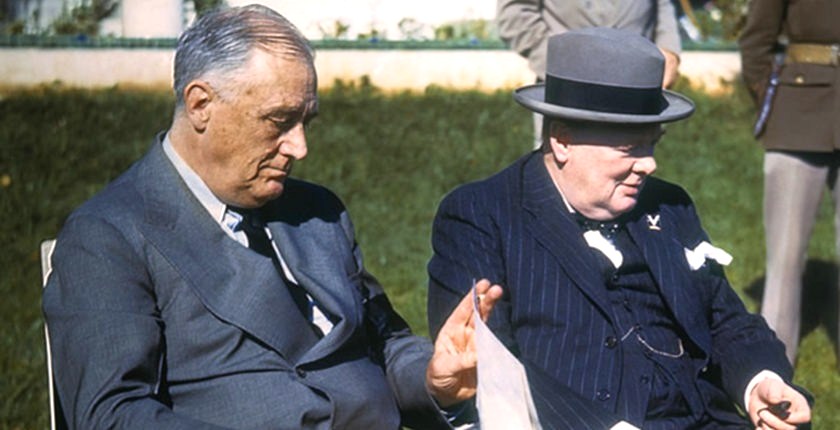
But I am also 2 or 3 degrees from President Franklin D. Roosevelt, and 3 degrees from a number of prominent figures of the World War II era, including Winston Churchill, General George Marshall and Harry Hopkins. And Adolf Hitler.

And as I recently discovered to my awe and astonishment, I am no more than 5 degrees from President Abraham Lincoln.

The route for these connections begins with Larry Jackson, a friend for several decades, who I met in Cambridge, MA.  He knew actor and famed director Orson Welles quite well.  Welles is my connection to FDR, Churchill, Marshall and others, who he knew.  (Recall that Citizen Kane was released in 1941, and before that, Welles was active in the Depression era Federal Theatre Project.  He campaigned several times for FDR.  Add to the many important people he met in his long life as a globe-trotting celebrity, those he met as the child of a wealthy and well-connected father.)  Welles also met Hitler when Hitler was a colorless member of the fringe Nazi Party.

I learned much of this from recently re-watching an interview Welles did with Dick Cavett, in which he also talked about a fascinating woman he knew when he was quite young and she was in her 90s.  And she had known Abraham Lincoln.

This started me considering other connections through time, and some are surprising.  I can name two routes through which I am 3 degrees from H.G. Wells, whose writing career began in the 1890s.  That puts me no more than 4 degrees from Carl Jung and Conan Doyle (not to mention Lenin and Stalin), and 5 degrees from Charles Darwin. Probably 5 degrees as well from Charles Dickens.

If my JFK handshake is allowed, I'd be two degrees from FDR (who JFK must have met when his father was FDR's Ambassador to England) and therefore 3 degrees from Teddy Roosevelt and others of that era, through FDR.

Through meeting Gary Snyder and Allen Ginsberg, I am 2 degrees from Jack Kerouac and William Carlos Williams. But through meeting Buckminster Fuller (grand-nephew of Margaret Fuller), I am four degrees  from Emerson and Thoreau.

I am also 2 degrees from Ernest Hemingway (through writer William Eastlake) and F. Scott Fitzgerald (through a waiter at his favorite St. Paul hotel bar.)  And through a writer I never met but with whom I exchanged letters, 2 degrees to Pablo Picasso.  They seem very remote now even in time, though all but Fitzgerald were alive in my lifetime.

There's something mysterious about all this and how it feels.  Maybe many mysteries in fact.  But at the very least it comports with a stretched sense of time that is acquired with age.  It is not surprising to me that I shook hands with JFK, heard Martin Luther King speak at the March on Washington, and also voted twice (actually four times) for Barack Obama. For someone younger, it might seem incredible. That's also how I feel when I look at the past before my life: it seems so remote and spread out.

So for instance I was astounded to read an interview with Rebecca West, once the lover of H.G. Wells, who mentioned meeting contemporary playwright Tom Stoppard.  Wells and Stoppard seem like figures in different time universes, which in most senses they are, but not altogether.  They were in fact alive at the same time, though barely.

Cocteau, Picasso, Stravinsky, Olga Picasso
Or that Jean Cocteau knew Braque and the young Picasso (and Gino Severini), and had his last film produced by Francois Truffaut.  In fact, only 30 or 40 years separates the Paris of Picasso from the Paris of Truffaut.  (And since I met Truffaut, I'm 2 degrees from Cocteau, and 3 from everyone he met, including Uncle Gino.)

Still, it is one thing to try to realize that my great-grandparents may well have been alive when Lincoln was, and another to be able to count the links in my chain of connection to Lincoln himself.  Especially since it is possible if not likely that none of my great-grandparents in their European hinterlands had much of an idea of who Lincoln was.

What is it about these connections?  In truth, I make more direct connections with these people through reading their words, listening to their music, watching their films and so on.  I guess some of it is physical.  The tradition of shaking the hand of someone who had shaken the hand of someone famous (however many hands are involved in that chain) goes back at least to a famed 19th century boxer John L. Sullivan.  I remember I spent a day shaking hands with my high school classmates when I returned from the JFK Inaugural weekend.

The physical connection suggests family or community, which is also I suppose the point of the degrees linking all of humanity.  Perhaps it also suggests the fact that we breathe the same air, that we are composed of the same molecules, as everyone living or who has ever lived.

But it also makes time, history and greatness more intimate.  A short chain of touch stretches from me to Abraham Lincoln.  I suppose that soon no one will be able to claim even those five degrees of touch, so this also grounds me in my time, even as it widens that ground.

Like any kind of historical consciousness, this suggests that more is possible than what we have in the present, and surprising elements of our present have close precedents in the past.  But it makes all that more visceral, while it nourishes and strengthens the imagination.

It also frees me from this moment, this troubled and slowly suicidal context, in which it seems scarcely possible that someone like FDR ever existed.  But a chain of touch of (at most) two people separates me from him, and links me to him.  Through those links, he lives.  In those links, I live.

Saturday, August 24, 2019

History of My Reading/ Fall 1967: The Music Is Your Special Friend

My first of three trips out of Galesburg during the fall term of 1967 was the October bus trip to the March on the Pentagon in Washington.  My second was the shortest: the 200 or so miles up to Chicago in early November, also with Knox College classmates, to attend a Donovan concert.

Judging by this ticket stub on sale on ebay, the concert was on Saturday November 11 at the Opera House on Wacker Drive at Madison St.  I don't recall exactly who went or even how we got there and back.  I only remember camping out overnight on the living room floor of Jeff Katz's parents house.  So I'm guessing Jeff was one, and maybe Steve Meyers, Howard Partner, Susan Isono, Karen Miyake--but those are just guesses.

Donovan was pretty much at the height of his fame.  After his folk period--influenced by Dylan and other American artists, but also with roots in Celtic traditional song--he had two huge pop hits in "Sunshine Superman" and "Mellow Yellow."  He was becoming a psychedelic troubadour, which was very much the imagery of this show.  In addition to his hits and other past songs, he performed songs from his forthcoming double album, Gifts From a Flower to a Garden, the musical expression of that imagery.   


His Chicago gig was part of a US tour. Amidst flowers, incense and other trippy trappings, each two hour concert began with an introduction by his father.  I remember that his first tune was the simple but mesmerizing "Isle of Islay." He played solo guitar, and then on some numbers he was accompanied by a jazz quintet (there were jazzy arrangements on his Mellow Yellow album especially), and did two songs backed by the Metropolitan String Quartet (according to a letter I wrote at the time.)

We had good seats in one of the center sections, third row--close enough, I noted in that letter, that we caught flowers that he threw into the audience at the end of the concert.

My third trip was the longest in distance and time.  In late November--probably during Thanksgiving break--I flew to San Francisco.  So months after the Summer of Love had cooled, I finally got there.

I went as an official representative of Knox College, to the national convention of the Associated Student Governments.  I suppose I got the gig because I was still one of the student representatives on the Faculty Student Affairs Committee, and possibly because I was one of the few students still around during Thanksgiving break.  There were three of us: Bill Larkin, Karen Miyake and me.  I don't recall seeing much of Bill Larkin while we were there, but I did hang out a lot with Karen.   


Demo against Dow Chemical and Vietnam War at U. of Wisconsin
in fall 1967--just one example of what this convention ignored. 
The convention was held in a downtown hotel, and I dutifully attended various sessions and seminars.  I wrote an article about it, published in the Knox Student. I noted that the male attendees mostly wore identical dark suits and thin ties, and seemed chiefly interested in promoting one or another candidate for ASG president.  It was clearly and disturbingly a clueless establishment organization, and I noted the contrast between the reactionary rhetoric and what was actually happening on university campuses at that moment. I heard with some satisfaction the luncheon speech by Paul Goodman (who had also been at the Pentagon), expressing my own evaluation. He asked, "Is the ASG for real?"

I recall one seminar I mention, that was billed as being about experimental colleges but was actually about sensitivity training and t-groups, the first time I'd heard of them, and I left laughing but with chagrin as I suspected there would be more and worse ahead (EST anyone?)

But I especially recall one session I didn't include in my article: a panel about drugs on campus.  I sat in the audience waiting for it to begin, and I suppose I was fairly conspicuous sans thin tie etc.  Apparently spotting my boots and long hair, someone came down from the platform to ask me if I'd like to come up and be on the panel.  I was clearly being asked as an obvious representative of the country's campus potheads (or "freaks" in the parlance of the day.)  As I had gotten authentically stoned for the first time earlier that autumn, I did not feel qualified, and immediately lost confidence in the panel itself.  I not only declined, I got the hell out of there.

Reading this article is interesting to me now because I see in it glimmers of the writing I would be doing professionally in a few years, for the Boston Phoenix and later for Esquire and other magazines: accurate reporting but with a cultural point of view. In this article I noted that: "We had also been issued a gift bag as we entered the hotel, which contained toothpaste, mouthwash, soap and deodorant, which meant that in addition to looking the same, everyone soon smelled the same as well."  (I noticed this phenomenon many times in later years at various conventions I attended as a reporter or speaker, though I began to see it as an unconscious element in the strange solidarity that often develops.)

But the memorable moments of the trip came outside and after the convention.  I don't recall how we connected, but one evening Jay Matson came by the hotel and drove me and Karen back to the apartment he shared with another ex-Knoxite--I believe it was Buddy Blatner. Their apartment was on an upper floor, with a view of downtown San Francisco, especially a fancy high rise hotel, all steel and glass, with a bubble-like glass elevator that operated on the outside of the building.  They told us an outrageous story of noticing one night that the elevator had stopped.  They tried to report this to the hotel, but instead got connected to the elevator itself.  It went on from there.  To this day I'm not sure if that actually happened, or Karen and I were the gullible audience of an urban legend.

On a glorious day we were driven up Highway One to the rocky seacoast in Marin County, surely one of the most beautiful places I'd ever been.  Mike Hamrin was probably there, and Mary Jacobson definitely was.  When I returned I wrote a song about that day (since lost), sort of on the order of "San Francisco Bay Blues."  The only line I remember was: "Mary's hair was shining for a thousand miles."

And I remember an evening that Karen and I saw a double feature at a theatre not far from the hotel: Doctor Strangelove, in the most incredibly brilliant black and white print I've ever seen, and The War Game, Peter Watkins' 1965 graphic and apocalyptic faux documentary about nuclear war and its aftermath in England.  It's the only time I've ever seen that film shown in a theatre, and one of the few times I've seen it at all.  The films were powerful and the walk back to the hotel decidedly melancholy.  We were continually fighting off the feeling of being a doomed generation anyway.

As for the residual Summer of Love, we visited Haight-Ashbury and I was not especially inspired.  It looked pretty tawdry.  The cannabis culture was more impressive.  In my few months of experience, I was used to watching seeds and stems being separated, small joints being twisted roughly into shape and passed around whatever group had assembled. In San Francisco, the joints were neat machine-made cigarettes in yellow paper, and everyone got their own.

I did make my way to the Avalon Ballroom, one of the two or three hip venues for the burgeoning San Francisco music scene.  I was hoping to see Jefferson Airplane but instead caught a new band called Big Brother and the Holding Company, with a raucous lead singer.  There was a light show blanketing the auditorium and I was pretty far from the stage, so I note with appropriate irony that I spent considerable time trying to figure out if the singer was male or female.  Female, I finally decided.  She was Janis Joplin.

Karen and I had stayed on after the convention was over.  I believe Jay hosted us. Then Karen looked at me sadly and said, "We have to go back."  It was true, and so we did.  But I didn't return empty-handed--the convention had unexpectedly provided some lasting souvenirs.  On its last day I heard someone say that a record company representative was giving away record albums.  I rushed to the appointed room, and got the last two he had.  One was John Fahey's Requia, a series of his meditative composition on acoustic guitar, which I listened to a lot over the years.

The other was the second album by Country Joe and the Fish: I Feel Like I'm Fixin To Die, which we played over and over that year on First Street, in the house Bill Thompson dubbed "The Galesburg Home For the Bewildered."

Karen and I arrived back at Knox in time for a dance in the darkened Oak Room.  Prominent among the music played that night were both sides of the just-released new Beatles single: "I Am the Walrus," and "Hello Goodbye."

Which suggests a point to be made about these 1960s college years: the music gave us pleasure, thrills, wonder, solace, the beat of our lives.  But it also provided much of the text of our lives as well.


Sergeant Pepper's Lonely Hearts Club Band was innovative in many ways, and one of them was the back of the album cover, imprinted with the words to the songs.  Printing the lyrics then became standard practice in the late 60s and 70s.  This only emphasized what was already true: these were the words we knew, we talked about, we even debated.  We communicated using them.

In fact I'd read an interview (and clipped it from a teen magazine) in which Donovan made this very point.  He referred to "Eleanor Rigby" as a three minute novel.

Of course, as Phil Spector had famously insisted (immortalized in a profile by Tom Wolfe), the meaning of the words was also in the music, the beat.  They couldn't be separated.  Still, these were the texts of those days as much or more than any books.

Movies were also important, of course.  We had access to some films from around the world, both old and new, including experimental film. Todd Crandall inherited the Knox Cinema Club, and deputized me to run a packaged experimental film series--which basically meant advertising it, picking up the movies and delivering them for exhibition in the Round Room of the CFA.

In those packages I recall a lot of trippy shorts and animation, especially from the Film Board of Canada, and a live action short I remember to this day, and have never been able to track down. (For awhile I thought it might be Steven Spielberg's Amblin, but it's not.) It was about a young male hitchhiker, picked up and seduced by a young woman, and then abandoned by the side of the road.  What I most remember is their conversation in the cabin where they spent the night.  She asked him what he wants to be, and he shrugged and said, "I'd like to be a Beatle."  Pretty much my less than secret sentiments. All of this led to interest in film techniques, and in 1967-68, English professor Richard Alexander offered the first filmmaking course I know of at Knox.

Even some Hollywood films were culturally important.  I made a list of a couple of dozen that were significant to us and the times in some way by 1968, and apart from the movies I've previously mentioned that were important to me, our generation more generally got catch phrases and visual imagery from movies as well as a few books.  During our time at Knox the most important movies generally would have to include Dr. Strangelove, Who's Afraid of Virginia Woolf?, Bonnie and Clyde, Blow-Up, The Graduate in 1967 and 2001: A Space Odyssey in 1968.

But music had a special place, and that school year of 1967-68 also happened to be a remarkable year for popular music.  Some years later, when I knew a lot of people in the movie business around Los Angeles, I was having lunch with some technicians working on an independent production--a sound guy and a camera guy.  One was an older veteran with lots of stories, the other was about my age.  He and I started talking about the albums released in 1967 and '68, at a level of detail that included the season if not the month of release.  "You guys sound like a couple of medieval scholars," the older man observed.

These days I need a little goosing from the Internet, but there are records I remember vividly.  With three housemates and assorted friends, this was the first time I had multiple people contributing to a common cache of albums.  We played older ones (all the Dylan electrics, for example) but the new ones came in a flood.
We arrived still listening to Sergeant Pepper as well as Hendrix Are You Experienced?, Jefferson Airplane's Surrealistic Pillow, Donovan's Mellow Yellow and Sunshine Superman, Dylan's Blonde on Blonde.  Tim Hardin's first two albums were making the rounds.  I recall watching Anne Maxfield stare intently at the phonograph as she listened to a Tim Hardin record to the end, then sent the needle back to the beginning again.

The school year began with the Doors' second album Strange Days joining their first;  Buffalo Springfield Again, Arlo Guthrie's Alice's Restaurant and Procol Harum, joined in late autumn by Cream's Disraeli Gears,  Jefferson Airplane's After Bathing At Baxter's, and (thanks to my San Francisco trip), Country Joe and the Fish I Feel Like I'm Fixin to Die.
   
Winter releases included Dylan's John Wesley Harding,  Hendrix Axis: Bold As Love, Traffic's Mr. Fantasy, The Songs of Leonard Cohen, Van Dyke Parks' Song Cycle, The Notorious Byrd Brothers, Aretha Franklin's Lady Soul, Steppenwolf, The Graduate soundtrack of songs by Simon & Garfunkel, The Who Sell Out, Donovan's A Gift from a Flower to a Garden, the Stones Their Satanic Majesties Request, and the Beatles Magical Mystery Tour.

The spring saw Joni Mitchell's first, the Supremes Reflections, Simon & Garfunkel's Bookends, Moby Grape's Wow/Grape Jam, the Papas and the Mamas, the Beach Boys Friends.

All these plus blues from Paul Butterfield and John Mayall, new albums from Motown, from Judy Collins and Joan Baez, and who knows how many psychedelic bands that came and went (the  Electric Prunes, Quicksilver Messenger Service, the Seeds, Iron Butterfly, Electric Flag, H.P. Lovecraft, the International Submarine Band etc.)

 Also on turntables were the Velvet Underground, Mothers of Invention (Frank Zappa) and the Fugs. I was listening as well to Ravi Shankar and this strange new singer, Harry Nilsson.

Bill Thompson introduced me to Vanilla Fudge, a white soul band gone psychedelic, and to the Buffalo Springfield's first album.  I listened to several songs on it over and over, and found in "Do I Have to Come Right Out and Say It" some echo of my own awkwardness.

 I  introduced him to the Bee Gees first album, and then their second (Horizontal) that winter.  He especially liked the song "Daytime Girl."  That year women students were wearing ponchos, some with Native American-style designs.  He saw a woman in a poncho raising her arms when he heard the line "spreading her wings like a high-flying eagle..."

The texts of the songs, and the songs themselves, reflected and articulated feelings and insights of the times, as well as of more timeless situations.  There was an edge to them borne partly by rebellious responses to the dominant culture.  They broke old boundaries, and though this was often due to new techniques, influences of different styles of music, and pure imagination, there was that element of cannabis and psychedelic drug experiences and the attitudes they suggested.

All of this probably made us more receptive to certain poets and writers working in other media.  But that is a subject for another post.

Ric Clinebell. Leonard Borden photo
First we read, then we write, as Emerson said.  First we listened, then we played and/or composed.  I learned what I could from the records, but housemate Ric Clinebell got a little frustrated with my guitar playing, and taught me a few basic bass runs and accompaniments.  Figuring out and learning new songs with different chords and patterns also inspired my own compositions.

Me and Steve Meyers, again on one of those
Knox construction sites.  Photo courtesy of
Howard Partner.
A few times--maybe including this year-- I sat on the floor in a circle with Dick Wissler and Steve Meyers as we improvised together on guitars.  I was not skilled as they were in playing licks low on the neck but I had noticed in the guitar improvisations by Country Joe and the Fish, there was a chord or chord pattern that anchored it all, so I did that.

I first remember Dick Wissler when he was in a band, and came into the Gizmo one night with his band mates.  They were standing at the counter when they suddenly broke into "He's a real Nowhere Man" in full harmony.  I thought that was the coolest thing.  Back home when Clayton, Mike and I learned those harmonies, I loved the moments when we spontaneously sang that opening line. One of us would start and the others immediately joined in.  We got it right every time.

This pretty much concludes this long-winded tour through my college years.  I dealt with the rest of my senior year in a series of posts around the time of my class of 1968's 50th anniversary (winter here and here, spring here and here)--these posts can also be accessed through the labels Knox College, 1967, 1968, 60s.

I will however continue with posts on "books of the 60s" that cover multiple years with additional memories for a kind of floating context.  And go on from there.

Saturday, August 17, 2019

History of My Reading/ Fall 1967: From "The Physicists" To The Pentagon

Iconic photo--and act--from March on the Pentagon Nov. 1967. Norman Mailer
wrote: "Posed against the line of soldiers, already some historic flowers
 were being placed insouciantly, insolently, and tenderly
in gun barrels by boys and girls." 
And suddenly I was a senior, at the top of the heap and the end of the line.  I got an early lesson in this fact when I arrived on the Knox College campus in Galesburg, Illinois early in the fall of 1967, with a couple of official responsibilities regarding the incoming first years.  I was re-experiencing orientation from the other side of it.

My first responsibility was in regard to the summer reading program for incoming first years.  In an earlier post ( here) I wrote at length about it from a first year's perspective in 1964.  It turns out that my class was only the second to experience this program, when we read the summer before we arrived about the science v. humanities split, through books by and about C.P. Snow, author of the Two Cultures thesis.  There were faculty-led discussions of these books as part of our Orientation week.

Bill Barnhart at one of the three ongoing construction projects
at Knox in fall 1967.  Photo by Leonard Borden.
 In 1967 the books were Giorgio DeSantillana's The Crime of Galileo and a play by Freidrich Durrenmatt, The Physicists. But instead of only faculty members leading discussions for the incomers, third and fourth year students would so for the first time.  There were 16 of us: Bill Barnhart, Jean Belieff, Diane Burwig, Joe Cecchi, Joni Diner, Jack Herbig, Kathy Karsten, Ed Novak, Mary Mangeri, Harvey Sadow, Wendy Saul,  Judy Schmidt, Ron Stern, Ted Szostkowski, Anne Wylie and me.

The Physicists was a fairly new play at the time, written in 1961 (in German; Durrenmatt was a Swiss national) and was a worldwide hit by 1963. It was first produced in New York and got its first US publication in 1964.  According to Samuel Matlock in his essay "The Physicists At Fifty": "Ever since, the play has been part of the canon of high school literature classes in Switzerland, Austria, and Germany, where it is also a favorite choice for high school theater groups and one of the most-performed dramas over the last half century."

The play takes place in an insane asylum where two inmates claim to be the famous physicists Newton and Einstein, while a third man, Mobius, says that he gets private instructions from Solomon.  Each of these men murders a nurse, which brings the police, who can't do much since the murderers are judged insane and are already incarcerated.

But it turns out that Mobius is a real physicist and genius, who has made certain discoveries that could create military supremacy for some political entity, and so he has faked insanity in order to be safely hidden away.  (Curiously, this is somewhat the subplot of the 1954 Japanese Godzilla movie I've written about recently,  Gojira.)  The other two--Newton and Einstein--are also actual physicists, as well being as spies from two superpowers trying to get Mobius' secrets.

Eventually, Mobius convinces them that the world will be much safer if they all stay insane.  But the head of the asylum has been reconstructing Mobius' burned notes, and is now bent on world conquest, under the personal instructions, she says, of Solomon.

The issues are similar to those raised by Gojira, though more complicated and paradoxical, reflecting an absurd nuclear weapons world.  The situation also suggests the 1964 film Dr. Strangelove, which some perceptive programmer scheduled as the movie shown in the Harbach Theatre during orientation.

Unfortunately I don't remember anything about the discussions (and would have forgotten my participation completely except for the Knox Student), and no longer have the books. I suspect however that some members of the Class of 1971 will remember something about them.

 But I very clearly recall my second duty, speaking on behalf of the student literary magazine as part of the introduction to campus organizations that so impressed me my first year.  It was evening, and there must have been several of us making presentations because I sat on the stage in Harbach Theatre for some time.  While I sat there, I wrote what became a kind of poem that would constitute my pitch. When it was my turn, I simply got up and read it--or more accurately, performed it.

It started out very well because I got applause just for the jacket I was wearing--a red team jacket that said Higgins Dairy on the back that I'd acquired at a Galesburg thrift store. (Higgins was a family store with counter and booths and a juke box on South Street near campus, a place I hung out at times.  It closed in 1972.)  In marked contrast to my hometown just weeks before, my long hair and look delighted this crowd.  It seems the 60s hit high schools at the same time as Knox--and perhaps more so, as I was soon to find.

What I wrote and delivered (called "Notes for an Introduction to a Definitive Poem on Sitting on Stages") was a kind of rhythmic poem or stand-up routine, a kind of parody of speeches, very much of the moment, including references to Harvey Sadow's coat, and political and cultural figures, with a few Knox in-jokes that no longer signify, plus a few actual references to the Siwasher (the aforementioned literary magazine.)  It's not much now, but it was great fun and as close as I came to one of my ideals for poetry, which was spontaneous music for the occasion, yet written with a shape rather than complete improvisation.  It was also total performance, since the audience observed me writing it as well as delivering it.  John Cage might have dug it.

Laurie Khan, from 1969 Yearbook
I met a number of first years during orientation, and through them I met others that became part of my senior year.   Laurie Kahn, Celeste Manking, Judy Bowker, Jane Langer, Carol Hartman, Steve Phillips, Michael Shain and Sherwood Kiraly come immediately to mind.  Laurie decided I should represent Flower Power at the Pumphandle.  I said if she made me a lei of flowers I would wear it. She did, so I did, which explains my Sergeant Pepper presence in the senior movie.

My fall 1967 term was unusual in that I made three off-campus trips, including one to each coast.  The first of these was a bus trip to the antiwar demonstration at the Pentagon in Washington in October.

By then I was living in a big wood frame Prairie Gothic house on First Street.  Once again I'd returned to find myself homeless when I suddenly didn't have the place I thought I had in the spring.  Bill Thompson offered space in the First Street unfinished basement, but thanks to the kindness of Leonard Borden who freed up one of his two rooms, I moved into a bright, airy front room looking out on the quiet tree-lined street.  (Leonard soon found another place he liked better, and Ric Clinebell moved into his room.  George Otto had the attic second floor.)

I believe all the First Street houses were owned by the college, preliminary to being torn down for new college buildings in a couple of years.  Two English department faculty also lived there--Richard Alexander and his wife next door to us, and a few doors down was Robin Metz and his family.  Both Metz and Alexander were there when the meeting to organize our participation in the Pentagon events was held in our back yard.  We stood in the waning sunshine with green tea in paper cups and Jimi Hendrix blasting from speakers.  I remember the mood becoming bleaker as the light dimmed and the temperature dropped, and the few people left contemplated the uncertain dangers ahead.  The March was organized by a broad and nebulous coalition, and nobody could predict what marchers would do, or how the Pentagon would react.

But enough people eventually signed up, the bus was hired, and we boarded on South Street in high spirits and with a Galesburg Register Mail reporter watching us. As I climbed aboard he asked me, in the abrupt way the question was always asked, "Are you a hippie?"  "No," I said, in my best John Lennon in Help! manner, "I'm a flippie."   It was a spontaneous retort, appropriately flippant, and I immediately forgot about it.  After we returned however, someone showed me the resulting newspaper article which helpfully explained that the flippies were a new Midwestern offshoot of the California hippies.  Who knew?

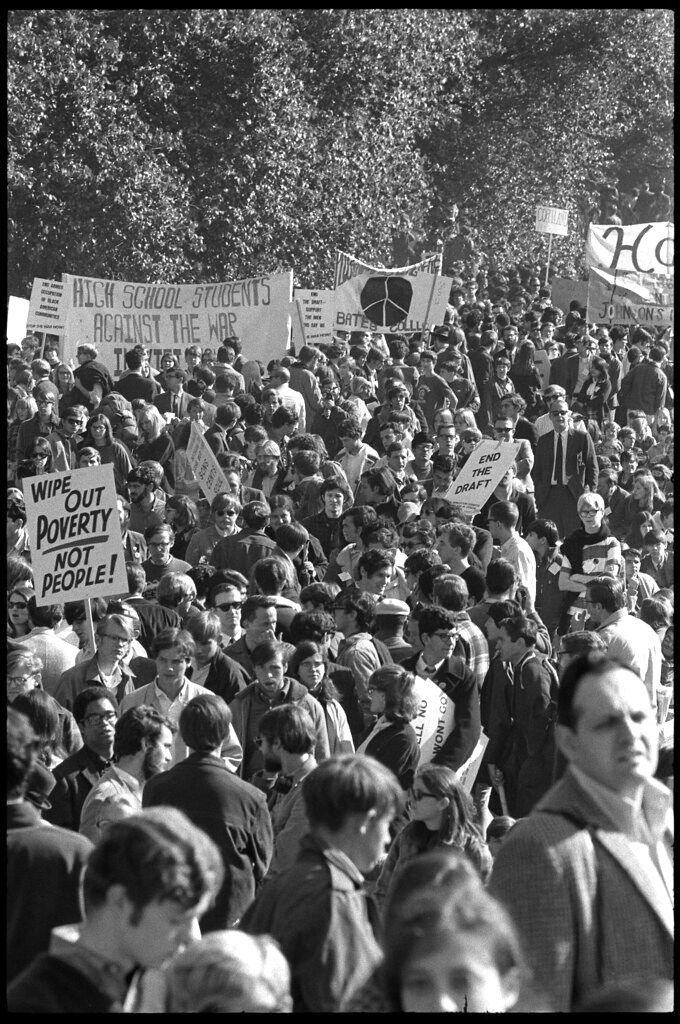
Though protest and civil disobedience events took place in the days before and after, the official March on the Pentagon was on Saturday October 21. Shortly afterward I wrote a few unpublished paragraphs about my experiences. It seems we sat in the sun near the Lincoln Memorial for hours, chatting while waiting for boring speeches to end, then walked en masse fitfully across a bridge, military helicopters buzzing over us "like Olympian mutant flies."

Our group must have been pretty far back in the crowd of perhaps 100,000 (maybe fewer, maybe more.).  By the time we got to the Pentagon we--that is, me and the people I was with-- basically became unequipped medics, helping people down a hill blinded by gas or mace, running damp cloths for gas victims and later, food and cigarettes from the parking lot to the area near the building where demonstrators sat, facing armed troops.
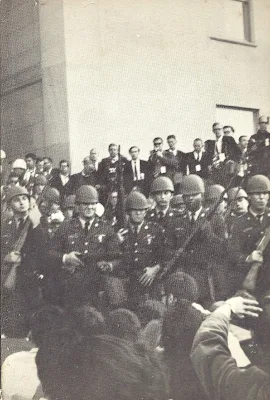
Siwasher cover by Jack Brown. Note
the soldier pointing his rifle at the crowd.
I do recall getting close enough to the building itself to witness a scene similar to the one captured by Jack Brown's photo which we subsequently made the cover of the March 1968 Siwasher.

Mostly what I remember is, later in the night, the sight of bonfires all over the huge Pentagon parking lot, as we waited for our buses, listening to sporadic stories and rumors about what was happening elsewhere, punctuated by loud indecipherable speeches and announcements from a p.a.,  sounding alternately pedestrian and hysterical.  Earlier some young men dramatically burned their draft cards.  I burned mine when we needed kindling for a fire to keep us warm.

My written description was part of an ongoing fictional account of this year, my never-ending and never completed college novel.  It was preceded by a paragraph that suggest part of my mood in this senior year, in the contexts of 1967-68.  "Before he left for the Pentagon, [name of character] did not feel in touch with his body.  He felt as if he were communicating with it over long distances, through weak signals, dimly, as if trying to see through rain.  Even when communication seemed possible...the code was imperfect."

"But for several days, starting with the day he decided to go, until sometime on the trip back, his mind and body worked together, were together.  They seemed, then, to know each other.  They might have been old friends."

Someone else's bus trip, but reminiscent
What I remember most clearly is not the Pentagon but the bus trip getting there. We had pretty much a full bus of students, including first years, with two faculty members, the aforementioned Alexander and Metz.   A younger student, Bill Long, has his guitar, and after he played it awhile, I asked him to pass it over.  I strummed it to myself for a second, realizing it was in some kind of open tuning.  He laughed--saying he wondered if I was going to just bash right in--and tuned it to standard tuning.

 Before moving on to some Donovan tunes ("Universal Soldier" by Buffy Sainte-Marie for certain), the only song I remember playing was the Woody Guthrie car song ("Take me for a ride in your car-car..."), the version done by Peter, Paul and Mary. Robin Metz approved of this latter choice, saying that the humor diffused the tension.  Tension?  He thought there was heavy male rivalry going on, which there might have been.  But I was clueless as usual.

The trip back at night was much quieter, as most of us slept.  When we stopped at one of those overlit highway restaurants and "comfort stations," several of our female students got fed up with the lines at the ladies' room and invaded the stalls in the men's room.  I remember Robin Metz observing, "this is the most revolutionary thing that's happened all weekend."

The definitive account of the March on the Pentagon was by Norman Mailer, eventually published in a National Book Award and Pulitzer Prize-winning book, The Armies of the Night. He wrote this shortly after the events, and estimated that there would never be a complete and accurate account.  As far as I know, there hasn't been.

Immediately after my fictional protagonist returned from the Pentagon, someone told him, "I hear Norman Mailer was there."  "Oh?" he said.  "I didn't see him."
And of course we didn't--we were too far back and away from the action, which included hundreds of arrests and some beatings.  We got our whiffs of tear gas, though--tear gas was one of the chief smells of the 60s.  So Mailer's account, which I read as it was first published in Harper's Magazine, remains separate from my experience.

But he makes general observations in the book, especially about the mood of the times, that reflected what I felt then--notably that America might well be insane.
He also made observations that I didn't believe then but that I do now, such as motivations for becoming part of a movement may well include self-pity and self-righteousness.

He was right about the feeling at the Pentagon that it was one kind of army confronting another, although he did tend to over-inflate the historical importance of this event (comparing it to a Civil War battle).  I don't recall believing this even at the time, though I certainly felt the sense of a besieging ragtag army huddling around its campfires that night in the parking lot.  I saw my participation as morally and politically necessary, and though I had hopes that these demonstrations would end the war, I feared it was probably futile. But I was too impatient to see it as the beginning of something that might last (as Mailer wrote) 20 years.  The six more years the protests and the war lasted were bitterly and soul-numbingly endless.

Mailer of course was up at the front of the action with the leaders of the March and the celebrities of protest.  This may be the distinguishing--and today the almost unbelievable-- feature of the Pentagon events, that its major celebrity leaders were one of America's foremost poets (Robert Lowell) and novelists (Mailer), and one of its major nonfiction writers (Dwight Macdonald, whose essay-review of Michael Harrington's book on poverty, The Other America, had thrilled me when I read it in the New Yorker in high school.)  As well as America's #1 baby doctor, Dr. Benjamin Spock.

Mailer deliberately got himself arrested, and seems to have gotten the stiffest sentence of any nonviolent protestor, though he spent only one night in jail.  He records for posterity some of the notable moments of preceding events, such as Yale chaplain William Sloane Coffin's defense of men who claimed conscientious objector status because they were morally opposed to the Vietnam War, though it was being granted only to absolute pacifists who could cite their church's doctrine: "...for the rights of a man whose conscience forbids him to participate in a particular war are as deserving of respect as the rights of a man who conscience forbids him to participate in any war at all." 

Mailer ends this book with a metaphor that has resonance for this historical moment in America, as it did for 1967:

"The death of America rides in on the smog.  America--the land where a new kind of man was born from the idea that God was present in every man not only as compassion but as power, and so the country belonged to the people; for the will of the people--if the locks of their life could be given the art to turn--was then the will of God.  Great and dangerous idea!  If the locks did not turn, then the will of the people was the will of the Devil.  Who by now could know where was what?  Liars controlled the locks."


I don't seem to have heard his name much in recent decades, but Norman Mailer was an important writer and major public figure from the 1950s through much of the 1970s.  He was so identified with the 1960s in fact, that when Esquire Magazine issued Smiling Through the Apocalypse, a still fascinating compendium of essays published in its pages that decade, a caricature of Norman Mailer was front and center on its cover, with James Baldwin and Tom Wolfe as acolytes.

Or maybe it's just me who forgot him.  I read a lot of his earlier and current work in the 60s and 70s, and he was an inescapable presence on the kind of television programs ( Jack Paar, Steve Allen, Dick Cavett, David Susskind, William F. Buckley, etc.) that mostly don't exist anymore.  (Can anyone today believe that frequent talk show guests once included Margaret Mead?  Or even that Esquire's reporters at the 1968 Democratic Convention included William Burroughs and Jean Genet?)

What remains of my Mailer book collection is negligible.  I used to own several of his novels, and I can't believe I lost Advertisements for Myself somewhere along the way. What remains is centered on the late 60s and early 1970s, when (if memory serves) I wrote about him a couple of times for publication, including a review in the Boston Phoenix of a collection of minor work titled Existential Errands.  


Mailer could be exasperating but he was usually provocative and sometimes stunningly articulate and insightful.  (Armies of the Night contains a version of my favorite Mailer quote: "Totalitarianism is the interruption of mood.")

He ran afoul of the women's movement (in its first dogmatic phase; we're currently in its second--witness "The Revolt of the Feminist Law Profs") with his book The Prisoner of Sex.  His views on sex were always weird (in Armies he calls himself a Left conservative, which describes more than his politics) and his views on women, while more nuanced than those times permitted,  were often off.  Still, I admired his almost chivalrous defense of the literary merits of D.H. Lawrence and Henry Miller.  In fact, he started me reading Miller.

I especially valued insights on writing and reading, some of which I remember as his (that a book and a reader must be ready for each other), and others I probably just absorbed.  After the new orientations of age and the changing times reduced his public presence, Mailer became more of a full-time novelist. Unfortunately for me, I couldn't get through the results.  I recall beginning a paperback of the Pulitzer Prize-winning Executioner's Song over coffee at the counter of Lee's Restaurant, but in the end I couldn't sustain hundreds of pages of interest in the subject of a murderer.

 I read some of his Egypt novel in a magazine, but that didn't motivate me to get the book. It seems his CIA novel, Harlot's Ghost, is considered one of his best, but again, not that fascinated with the CIA, at least not yet.  Unafraid of incredibly large themes, his last two novels were The Gospel According to the Son (as told by Jesus) and The Castle in the Forest (about the youth of Hitler, the New York Times best-selling book of 2007, the year of Mailer's death.)   They passed me by completely. These books and this reader were not yet ready for each other.

Mailer's polemics remain memorable, especially his concentration on the spiritual as well as physical disaster of pollution, television commercials, the corporate culture and both actual and metaphorical plastics.  He ranted early and often until these observations became common ground.

By the 1990s and during as much of this century as he lived, his sense of history was astute, as expressed in various interviews (some of them now on YouTube.)  He saw what I saw: a certain American--and perhaps, human--path of progress destroyed by Vietnam and the assassinations of the 1960s.  He also remained highly cogent on literature and the soul of a writer.

So maybe he wrote too much and he talked too much, and exhausted us all.  But he remains a complicated model of intelligent inquiry.  In my notes still stuck in my 1972 copy of Existential Errands, evidently for that review, I describe his process as running experiments in his mind, and reporting on them in detail. (I recall that my--male--editor would have preferred a simple hatchet job.)  When Mailer was right he was stunningly right, but just as importantly, he had the integrity and courage to be wrong.


Wednesday, August 14, 2019

The New Normal: The Accelerating Extreme

    WA Post:Remains of a home moved back from encroaching sea levels in RI

In a way it was a headline I dreaded to see for thirty years, and it appeared yesterday in the Washington Post:  Extreme Climate Change Has Reached the United States.

This long, careful story--calm, specific, with a minimum of jargon, replete with photos and interactive maps (there's also a podcast version)--is a snapshot in context, the America that exists this summer in the context of the ongoing process of global heating since the 19th century, but most consistently registering since 1970.

It notes that the goal of the Paris Accords to address the causes of global heating and the resulting climate crisis was to keep the global temperature "well below" a rise of 2 degrees C from 1895 levels by the turn of the century, which scientists marked as indicating catastrophic consequences.

Baltimore, from earlier WAPost story
The story reveals that in several places in the US, the 2 degree rise has already been exceeded.  These tend to be in northern states, at high elevations or on sea coasts (particularly the Atlantic), and/or the biggest urban concentrations that generate their own heat to add to the atmosphere, chiefly New York City and the LA metro area.

They begin with New Jersey where for generations a lake froze over every winter, with ice so thick that a winter festival could be held on it.  But where the ice no longer freezes that deep, or at all.  That's also the first point: that so far, despite hotter summers, the rise in average temperature comes from warmer winters.

The northern aspect comports with other data, that temperatures are rising fastest in the Arctic at least as far south as Alaska.  Rising winter temperatures may be temporarily pleasant,  but disease-bearing insects that normally would die back in the cold now can become more profuse in the warmer months.  And ice and snow that reflects heat no longer can when it's gone, and so both the land and the oceans get progressively warmer, raising sea levels.

This news is not surprising to me, though it is still shocking.  I know as well about the mechanisms that make this dangerous for the future: the feedback effects, the time lags--so global heating feeds on itself, and the effects come long after the causes.

 I once thought that these were the most challenging aspects of the climate crisis--these apparently new features of complexity.  But it seems to have turned out that the responses falter on the same primitive level of fear, selfishness and willful denial as in the past.

There's not a lot to say about what this means for the future.  That's pretty obvious, and it's not good.  It is however further confirmation of the road we're on--and that we're a ways down that road.

Personally, I would like to endorse what the aging  H.G. Wells said he would like for an epitaph: "God damn you all, I told you so."  Wells was one of the best known writers of his time, with a wide public that included the most powerful people in England and America.  Yet his warnings--of World War I, of World War II, of the atomic bomb--went essentially unheeded.  I wrote a few pieces published in newspapers on the climate crisis, and posted on what were then popular community blogs, beginning in the early 1990s.  But basically I've been making my points on blogs that nobody reads.  I am therefore not surprised I've had no influence.  So such an epitaph for me would be pointless.  Nevertheless...

Tuesday, August 13, 2019

Who Knows Where the Time Goes


Fifty years ago I was in Berkeley listening to Abbey Road, Crosby Stills & Nash, and the haunting new album by Judy Collins, who I'd heard performing months before at Red Rocks in Colorado.  This is her 2002 performance of the title song, "Who Knows Where the Time Goes?"  Indeed.